
Welcome to the Skeptical Investor Newsletter. A frank, hopefully insightful, dive into real estate and financial markets. From one real estate investor to another.
The Weekly 3 in News:
Rocket Companies to buy real estate firm Redfin in $1.75 billion deal. Why? Do you use RedFin or Zillow? (CNBC)
Market turbulence, Tariffs, DOGE, federal spending, tech valuations, AI / Chip Demand, China…investor Brad Gerstner thinks we are in a choppy bull market with a light at the end of the tunnel (Gerstner).
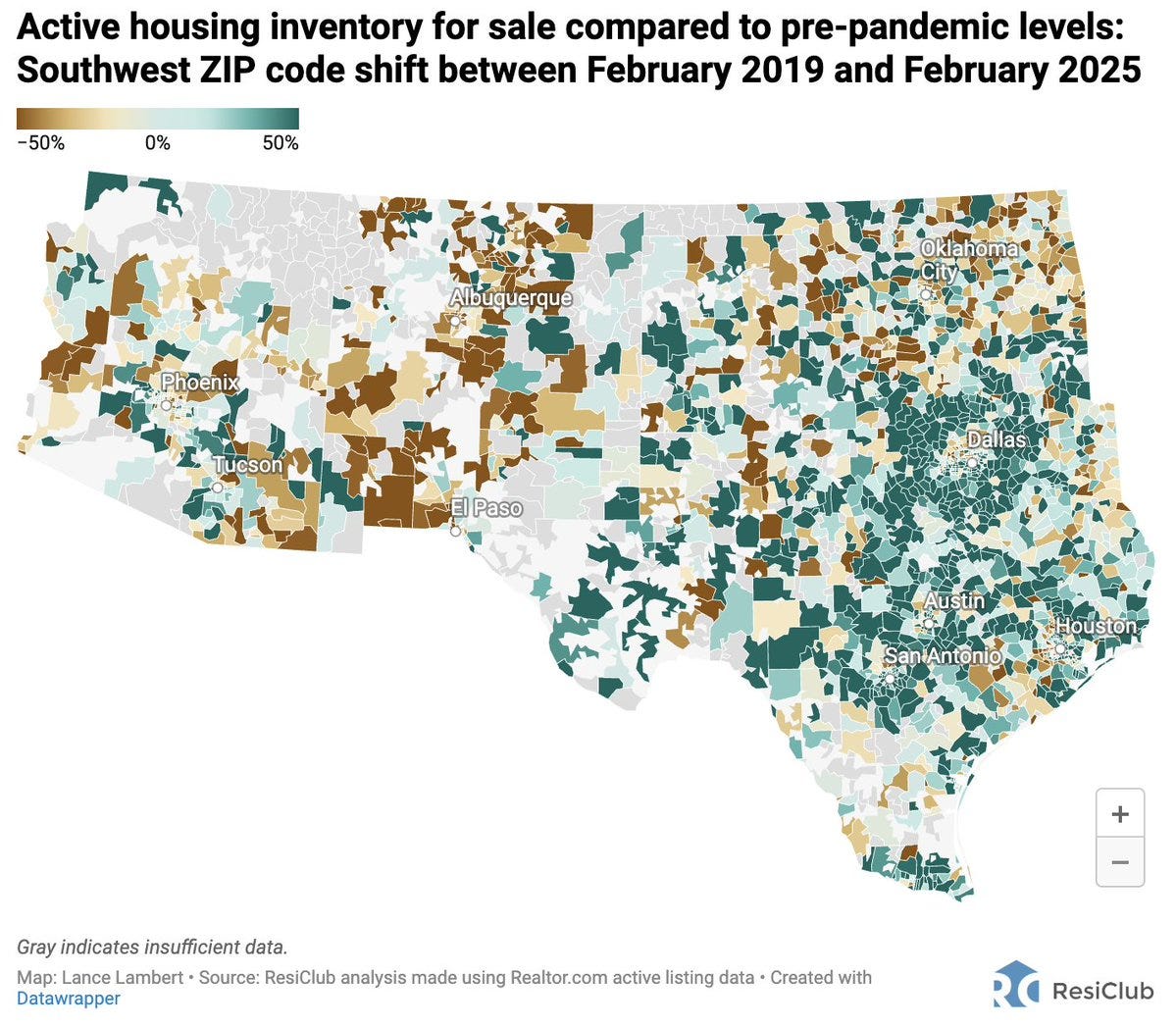
Over the past 32 months, homebuyers have gained leverage in many parts of Texas—especially in areas that were red-hot during the Pandemic Housing Boom and have high levels of homebuilding (Lambert).
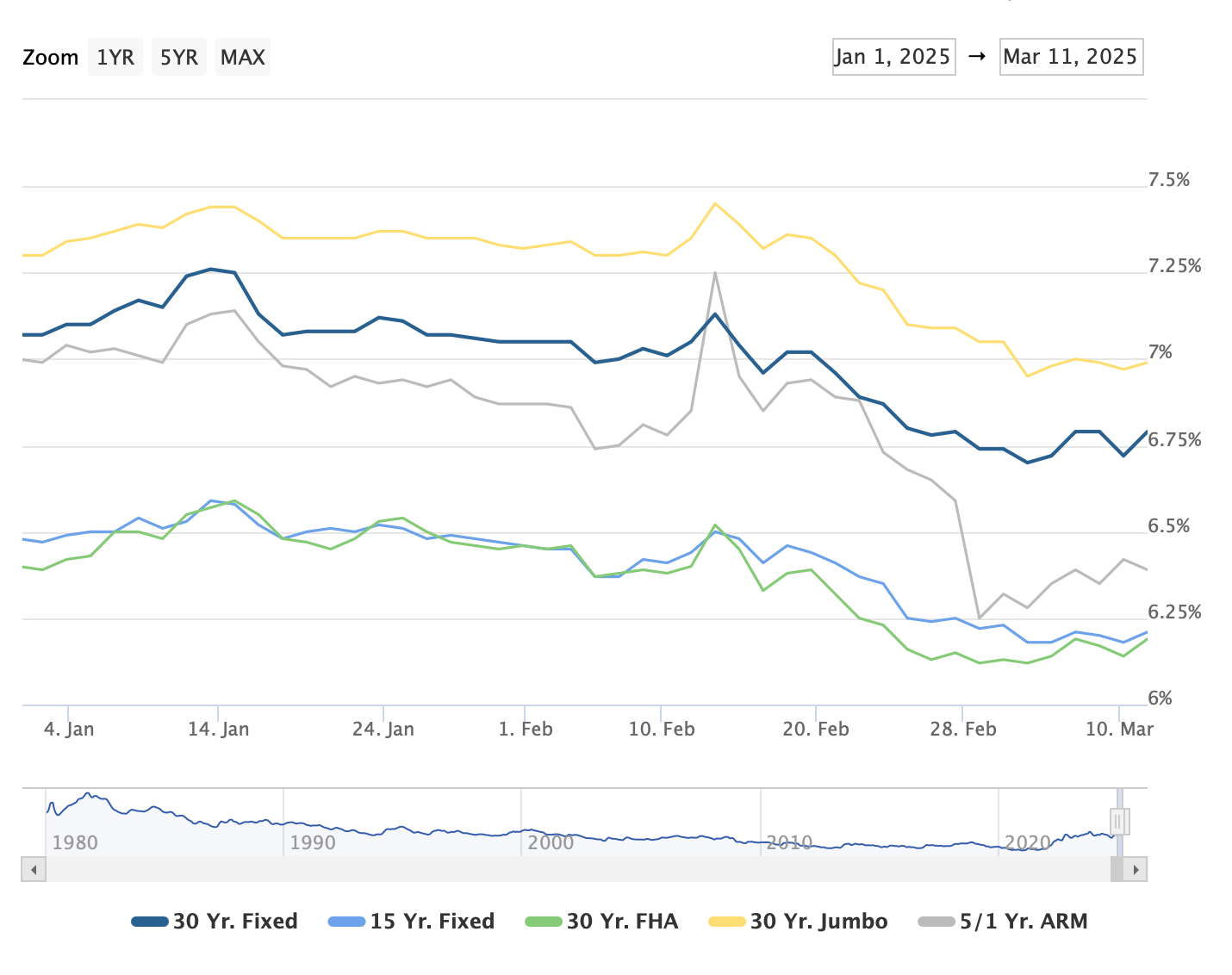
Today’s Interest Rate: 6.79%
(☝️.09% from this time last week, 30-yr mortgage)
Today, we’re talkin’ the state of the economy, market cycles, and why owning assets, like real estate, is so important when folks are panicking.
And with trade wars and tariffs heating up, it’s worth a hard look. Canada’s already dumping U.S. Treasury bonds like a hot potato in retaliation. Is a sudden economic stop possible?
Buckle up. Let’s get into it.
A peculiar thing happened last Friday (and really for the last week+): consumers, traders, agents, friends, long lost family members looking for financial advice, and definitely the news media all… turned supremely negative.
The stock market opened down 1.5% Monday and promptly careened off a cliff. Today we opened up big, then slammed back down again.
What gives?
I’ve been following markets, real estate, the economy etc…. for nearly 2 decades and outside of the Great Financial Crisis or maybe COVID I can’t remember the last time I saw this type of negativity whiplash and political finger-pointing punditry.
Case in point, on Thursday last week the Atlanta Fed went from forecasting 2.3% GDP growth to - 2.8% in one week?
Really?
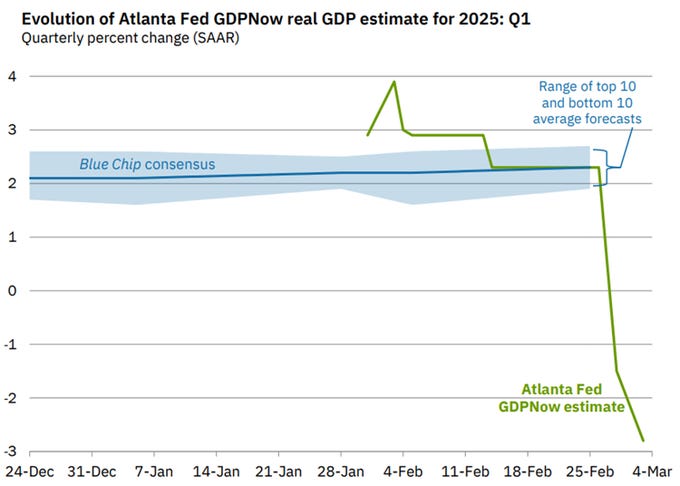
Atlanta Fed, what’s your thought process here? My DMs are open.
What Gives?
What occurred to get folks in such a funk?
Tariffs? I don’t buy it. Nothing has actually happened.
Potential government “shutdown?” Nah, that’s salacious headlines. Nobody cares.
Trade war got you down? Hmm…. I have some thoughts.
Was this skittishness already under the surface at the end of last year? Perhaps. But economic indicators have been steamrolling, and today’s inflation reading at 2.8% was better than expected.
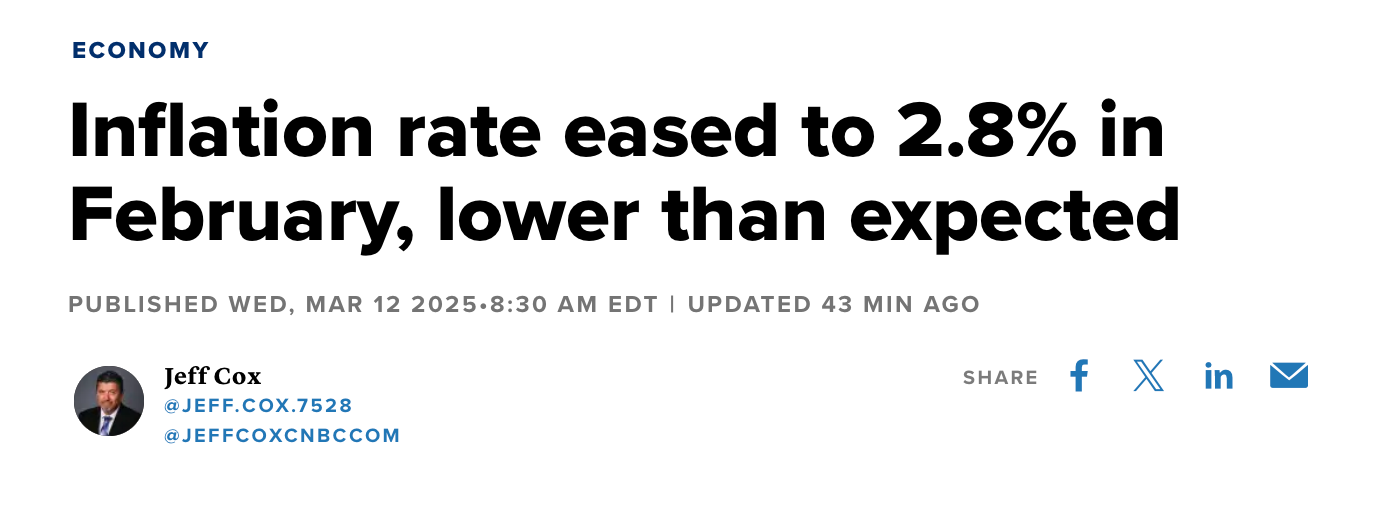
Frankly, this smells a little bit political to me - which I uber-hate blaming things on. That’s an easy out. But the Atlanta Fed thinks we are currently experiencing a recession.
Really? That’s hard to wrap your head around.
But let me try and steelman this.
Markets run in cycles and with momentum.
And the thing about both bull and bear markets is, they are self-fulfilling flywheels.
Negativity can rapidly set in, even if it’s not warranted. Remember, 2/3 of GDP is consumer spending. If the consumer starts to get pessimistic, that matters. After all, one household’s spending is another household’s income.
We have been in quite the bull market for quite a while. Too good, in fact, without a correction. The worry has been teh opposite of recession, an overheating economy and price inflation, which has been the case for 2+years. Just a few weeks ago this was all the news media was talking about.
So is the economy actually shrinking? Are we in a recession?
Gov Spending’s Role
I think the market, especially the bond market, is reacting to economic signals on disinflation, confusing messaging / uncertainty from the White House on trade and DOGE spending cuts, and lower than projected federal spending. Far less than was projected even just a few weeks ago before the Administration started canceling spending contracts at a rapid pace. IMO, as we start to close the government spending spigot, market participants are having a taper tantrum, (especially in the reactionary stock market). And I have the receipts…keep reading.
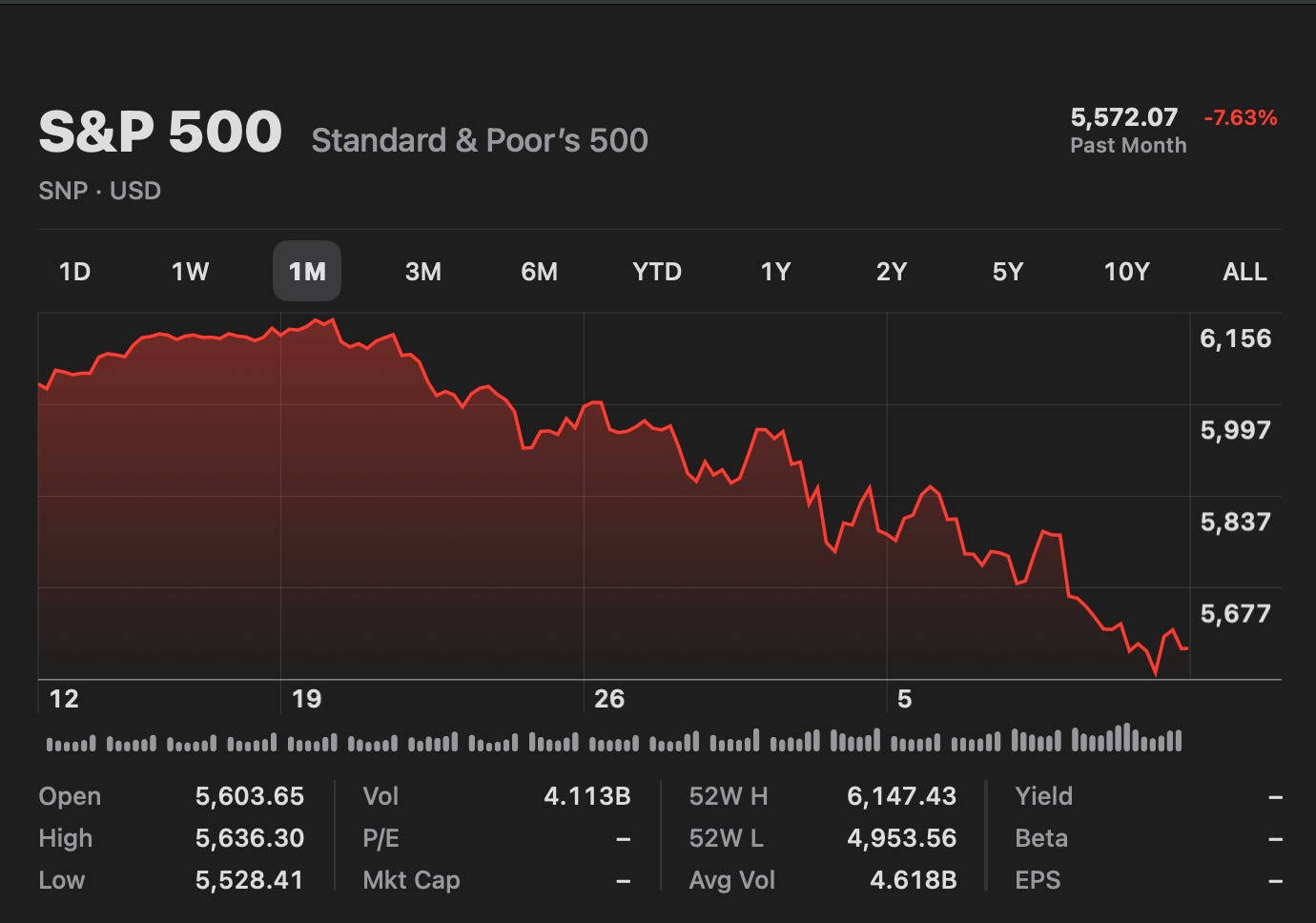
Additionally, the foundation may be cracking on a fugazy economy. The time may have come to atone for the $10 trillion in government over-spending during COVID. And as inflation finally comes down to earth, and spending slows, it is revealing a market distorted.
Could this then slow GDP?
Perhaps, yes.
A better question/thought: perhaps we should question whether government spending should even be included in GDP calculations? We already some of gov spending as “transfer payments” from GDP because nothing gets produced (ex: a welfare or social security check). But maybe we should exempt all gov spending from GDP calculations since they are a form of wealth transfer, IMO. To me, it artificially warps growth measurements. Maybe the true US GDP (ie a measurement of what we do and produce) is not slowing? Seems like it to me.
Fun fact, currently the government is “responsible” for ~30% of GDP.
What we need to know today is: where are we in the economic cycle?
How economic cycles work
Want to better understand the economy and its cycles? Famed investor Ray Dalio made a fantastic animated video on this a few years back. It runs through market cycles and even highlights why owning assets, like real estate, is so important.
Watch this, it’s extremely well done.
What did you think? Where do you think we are in the credit cycle?
When the music stops: A sudden economic stop vs recession
What we always do want to be mindful of is a sudden economic stop, leading to a recession. This differs from a typical recession. IMO this is what we need to watch out for as we start messing with foreign trade wars and tariffs. Fun fact, Canada just started selling US treasury bonds as a retaliatory method…
Sudden Economic Stop - A sudden economic stop refers to an abrupt and severe disruption in a country’s access to external financing. Capital flows abruptly slow/stop, credit freezes, banks stop lending, no bueno. It occurs when [often foreign] investors or creditors suddenly withdraw or stop providing funds (again, e.g. loans, investments, or capital inflows) to a country, often due to a loss of confidence in its economy. This phenomenon is most commonly associated with emerging markets or developing economies that rely heavily on foreign capital to finance trade deficits, government spending, or debt repayments. But it can happen to us.
Key Features:
Triggered by external factors, like a shift in investor sentiment, geopolitical instability, or a currency crisis.
Leads to a sharp decline in capital inflows, forcing the country to quickly adjust its current account balance (e.g., reducing imports or devaluing its currency).
Often accompanied by a financial crisis, such as a banking collapse or currency devaluation. Ie the Great Financial Crisis of 2008.
Economic Recession - An economic recession, on the other hand, is a broader and more general term describing a significant decline in economic activity across an economy, lasting for an extended period (typically at least two consecutive quarters of negative GDP growth and longer). It’s not necessarily tied to external financing or capital flows but can result from a variety of internal or external factors.
Key Features:
Characterized by falling GDP, rising unemployment, declining consumer spending, and reduced business investment.
Can be caused by domestic issues (e.g., a housing bubble bursting) or external shocks (e.g., a global oil price spike).
Affects the entire economy, not just its external financial position.
Measured by indicators like GDP, industrial production, and employment rates.
Relationship Between the Two
A sudden economic stop can lead to a deep recession if the loss of financing causes a sharp contraction in economic activity (e.g., businesses fail due to lack of credit, or imports collapse, hurting supply chains). Think of a sudden stop as a car running out of gas on a highway because the fuel station suddenly shuts down. The car stops abruptly. A recession is more like the car gradually slowing down due to engine trouble or bad road conditions—it’s a broader, slower breakdown.
Is a sudden stop happening?
I don’t see this, yet. But it could. And we are in the early innings of this trade war fun. Regardless, we want to always remain vigilant and protect our downside.
After all, we are Skeptical Investors.
As Warren Buffett once said:
“You don’t find out who’s been swimming naked until the tide goes out”
Today’s sponsor is…me!
Ready to Start Investing in Real Estate?
We are real estate agents for investors, because we are investors. We specialize in helping investors find, analyze and negotiate great real estate deals, as well as manage their rental properties, here in Nashville, TN. We pride ourselves on being tough negotiators. We want our clients to get an amazing deal, we never let our clients pay retail.
If you are looking for an investment property, give us a call today!
You can also find out more about us and what we offer on our website: www.NashvilleInvestorAgent.com
Why we care: real estate in any market
No matter the way the winds are blowing, there is always an opportunity when you own assets (again, see the video above). Today, fear is driving a flight to safety and bond market buying, which lowers the cost of capital/interest rates.
Today the 10-yr treasury (which the mortgage rate tracks) is down to 4.31%, and is highly volatile.
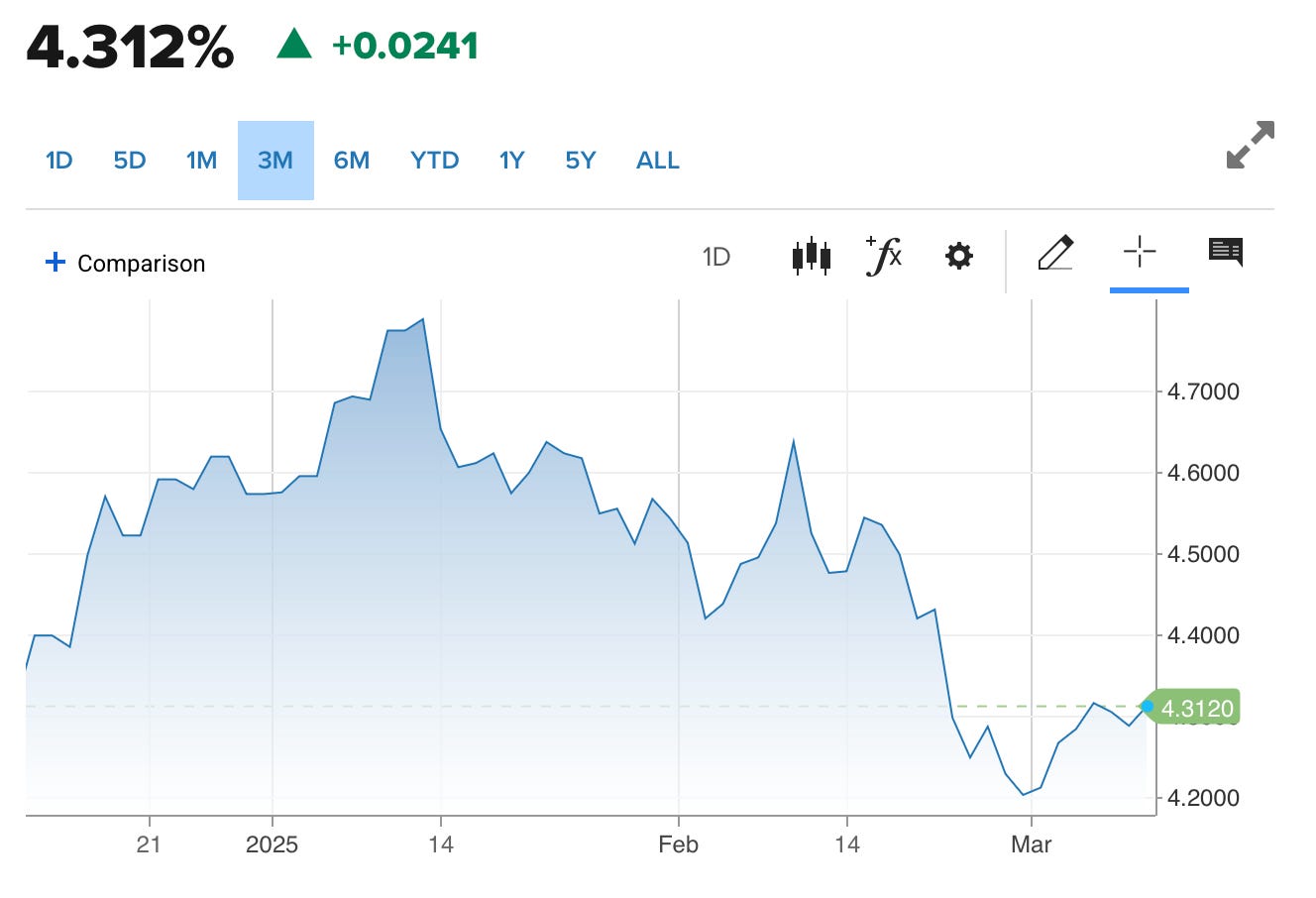
The 10-yr could finally be giving us a strong signal about disinflation, market uncertainty and even a slower economy.
My thoughts:
I thinkinflation has been successfully smashed, we have arrived at our 2% target. We will find this out in hindsight, once the data comes out.
GDP could be lower today than the 2.3% we thought it was, but is it negative? I dont think so. Not yet.
BUT, there is tremendous uncertainty with the trade war. Markets dont like this.
The silver-lining?
Real Estate gets more affordable and investors benefit from lower interest rates.
The good news, it is cheaper today than yesterday, and cheaper yesterday than a month ago, to buy a piece of property. Mortgage rates have been down every week since November and continue to tick lower. Remember, lowering interest rates is the current proclaimed mission of this US Treasury Dept. and they are following through on this plan, albeit with market tumult and "growing pains.”
In his words, Treasury Secretary Scott Bessent is trying actively to lower interest rates, saying: "The other thing that is important is that mortgage rates have come down and the spread between mortgages and Treasuries have come down since November—which I think is indicative of some of the things we're going to do in financial deregulation."
Consider Becoming a Paid Subscriber!
Paid subscribers get the best stuff, including a one-on-one call with me personally. Paid Subs get the best stuff. So make sure to take advantage.
My Skeptical Take:
Investors gain when markets panic, if they are positioned to take advantage.
In my opinion, we will still hit 5% interest rates in 20205. And on the way down, starting this Spring, it could be the best time to buy real state in the next 10 years. Rates are down, personal savings and earnings are strong. Tenants are in a strong financial position and unemployment is very low….
Recession, sudden stop… no matter! My bullish meter is at 120%. I just finished my latest project and am aggressively looking for my next property.
When sentiment sours, buy assets. I prefer real estate.
IMO, markets are reacting to negative sentiment, caused by political tumult.
This feeling is understandable, it’s been quite the last 45 days. Government is moving like a business that has acquired a bankrupt company and is on the warpath to turn it around.
But, this perception is misplaced.
Treasury Secretary likely put it well, saying a few days ago: “There is going to be a natural adjustment as we move away from public spending to private spending…the market and the economy have just become hooked. We have become addicted to this government spending and there is going to be a detox period.”
Fed Chair Powell, agrees, who is hardly a fan of the new President, saying “Despite elevated levels of uncertainty, the US economy continues to be in a good place…Sentiment readings have not been a good predictor of consumption growth in recent years.”
Hear hear.
Feelings are not facts.
And let’s be honest. Most folks in the market are wealthy.
Sorry it’s true.
And for the wealthy, it’s not about the money. It’s the mood. The wealth effect for them is quite pronounced. They will pull back aggressively with their spending/buying when the stock market plummets and makes them feel poor.
Good.
Time for the rest of us to buy assets. Again, I prefer real estate.
In fact, real estate can be best when roundabout investing, as investor Mark Spitznagel puts it. Investing is for the long term, not tomorrow. And it may be best as a “circuitous means toward the ends of productive capital investment.” We must have awareness of market distortions in the economy, such as the government stimulus, which magnify the human tendency toward immediate returns.
This is when we investors take action. All this uncertainty
For real estate investors, perseverance and tenacity, especially in the face of negative sentiment, bring the payoff, rewarding those who are not obsessed with today and, instead, have a depth of market perspective for tomorrow.
And for the love of sanity, don’t buy some “trade war survival” course from a slick X account. Hit me up instead—I’ll swap thoughts over a beer (you’re buying).
Stay vigilant, folks. The market doesn’t care about your optimism.
Markets cycle. Keep calm. Invest accordingly.
Until next time. Stay Curious. Stay Skeptical.
Herzliche Grüße,
P.S. Want to protect yourself from stock market volatility? Buy a rental property, buy real estate. Don’t know where to start? Give us a call! We got you.
Subscribe Today! (and get some amazing perks)
Paid subscribers get the best stuff! Join the Skeptical Investor Community to access:
Premium content and NO paywall,
Every article we have published - a treasure trove of information and education,
Conversations with other investors in the Skeptical Investor community, and future meetups and special events,
Key insights and predictions on the latest financial news,
PLUS, subscriptions include an annual one-on-one call with me personally. So make sure to take advantage! Subscribe today.
Just $5 bucks a month.👇
We have passed 10,000 subs! Thank you for your support, next stop, 20,000!
Please help grow the community!
It takes me several hours to write this weekly article, and they will always remain free (but you get some pretty cool perks with premium, including a one-on-one with yours truly :). All I ask is that you share it with 1 friend. Just 1. If you do, you will get two gifts: free education for one of your friends, and good karma for helping to grow a community of folks trying to figure out a way to create wealth for their family.
What, did you think I was going to send you a Starbucks gift card? 😅
Ready to Start Investing in Real Estate?
We are real estate agents for investors, because we are investors. We specialize in helping investors find, analyze and negotiate great real estate deals, as well as manage their rental properties, here in Nashville, TN. We pride ourselves on being tough negotiators. We want our clients to get an amazing deal, we never let our clients pay retail.
If you are looking for an investment property, give us a call today!
You can also find out more about us and what we offer on our website: www.NashvilleInvestorAgent.com
Why Nashville? There is always a bull market somewhere, and one of them is Nashville. We have the lowest unemployment rate of the top 25 major cities and folks are moving here to take those jobs. Nearly 90+ people per day move to Nashville. And tourism continues to hit record levels. This past year 16.8 million folks visited our lively city. Plus we have 3 professional sports teams (hopefully a 4th soon), massive healthcare and entertainment industries, heavy manufacturing, more than a dozen colleges, no state income tax… to name a few amazing advantages. Come check us out, the water is warm :).